
Buy a Hyperbaric Chamber
with Confidence
Hardshell chambers from 2 ATA to 6 ATA, supplied by experienced HBOT technicians — not salespeople. We help you select, check on arrival, install and learn to operate your chamber safely. Prices start from NZD $50,000.
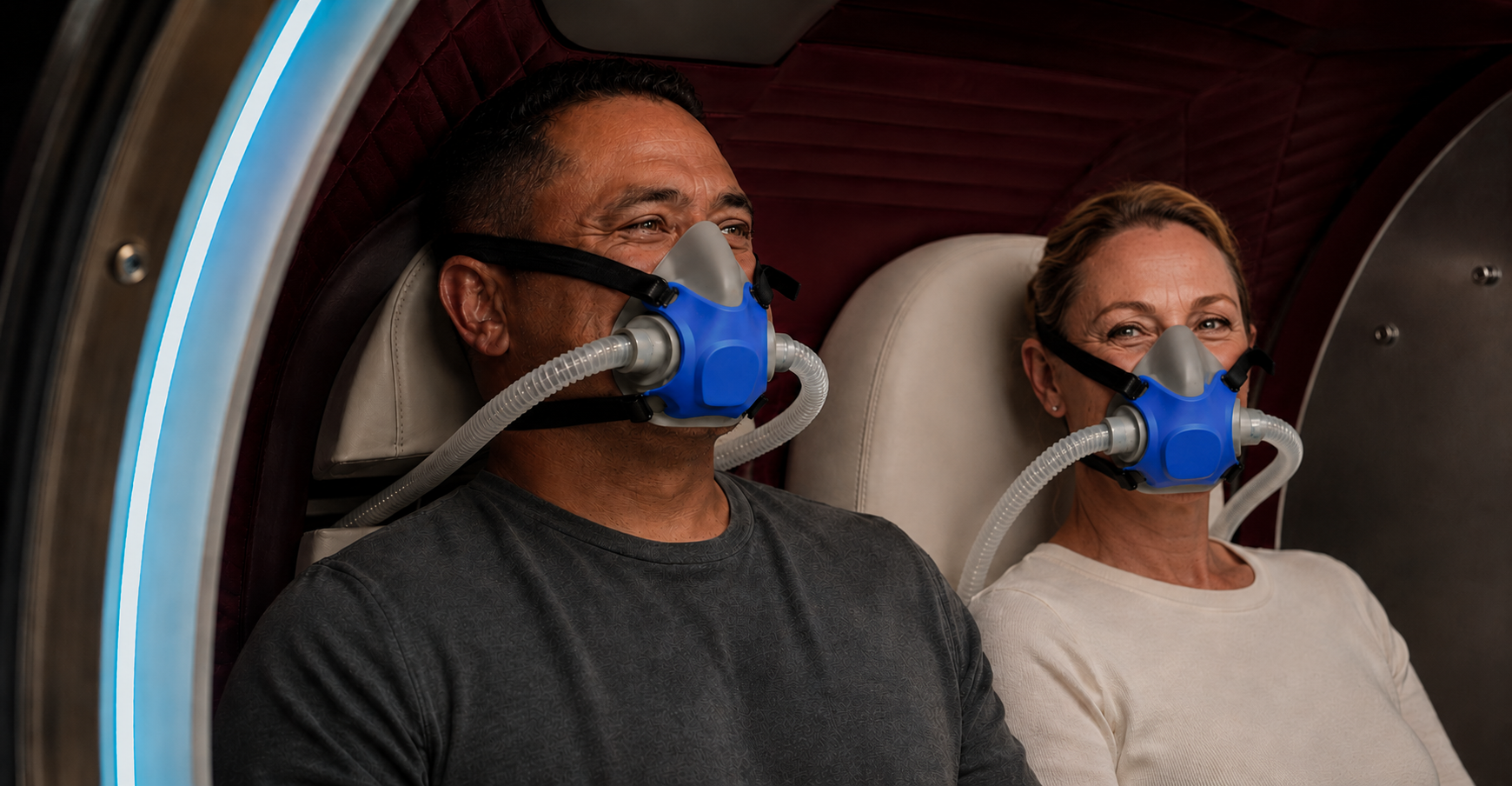
5 reasons to buy through an experienced HBOT operator
We're technicians, not salespeople
Our team has over 20,000 hours of hands-on chamber experience. We own and operate our own hardshell multiplace chambers — so the advice you get comes from people who actually run HBOT, not from a commission-driven sales rep.
You won't pay more than buying direct
Our pricing is never higher than going straight to the manufacturer. You get our guidance, selection help and installation support at no premium over a direct purchase.
We select, check and install every chamber
We help you choose the right chamber, verify it on arrival, and install it correctly. The chamber that turns up is the one we'd put in our own clinic.
A NZ-registered GP consults with you
Because we've supported clients across many health conditions, we can speak from real experience — and your purchase includes a consultation with our own New Zealand registered GP as part of the selection process.
We teach you to operate it safely
We own three different brands of chambers ourselves, so we know HBOT from every angle. We also train you and your family to run and operate your chamber safely before handover.
We know HBOT from every side
We own three different brands of chambers ourselves and operate them daily — so our advice is grounded in real experience across many health conditions, not theory.
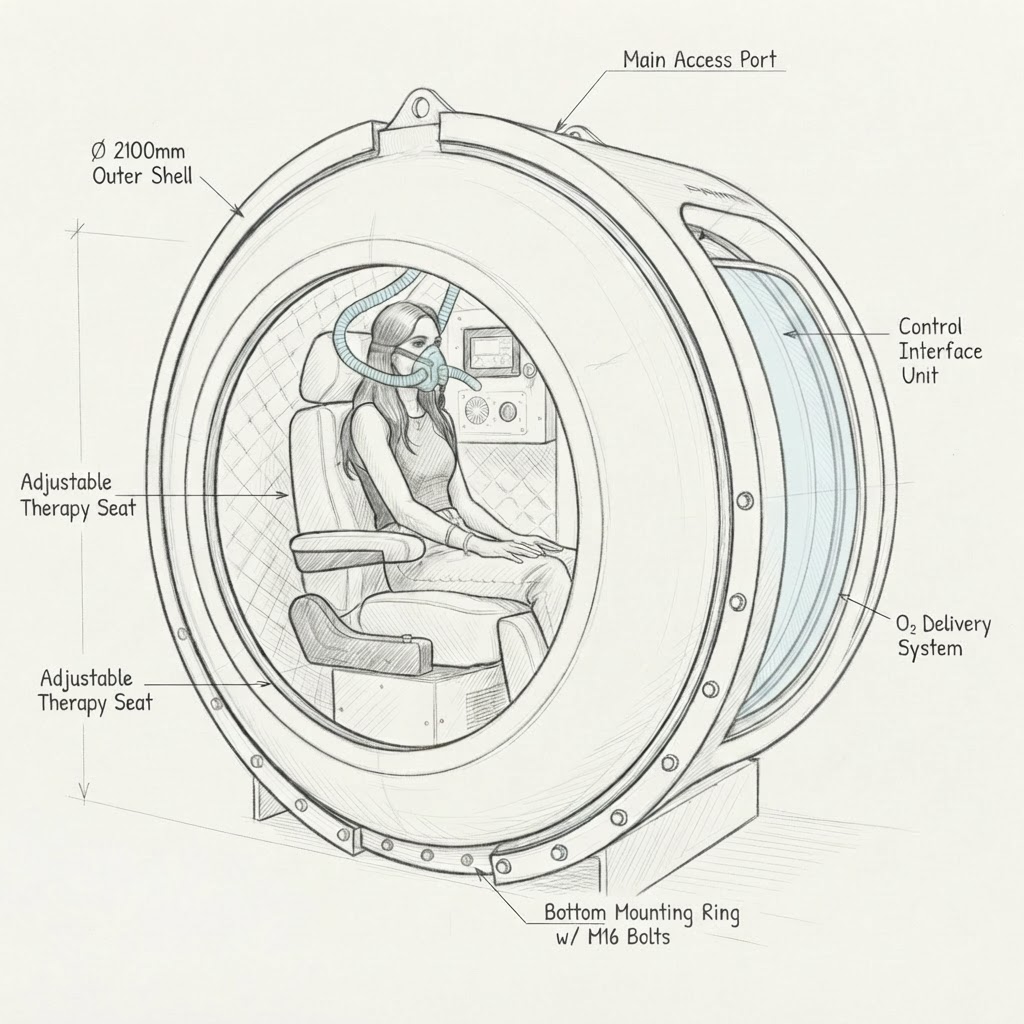
The chamber, drawn the way we think about it
Structure, airflow and safety points — the details we check on every unit before it's installed.
Mistakes people make when buying HBOT chambers
Unfamiliar buyers often choose the wrong chamber — which limits outcomes and wastes money. Here's what to watch for.
Choosing the wrong pressure range
Soft-shell and low-pressure chambers cannot deliver the pressures some protocols require. Buying too low a spec means limited outcomes — and often a second purchase later. That is why we only supply hardshell 2 ATA to 6 ATA chambers.
Sizing the chamber for today, not tomorrow
A single-seater feels right until a family member needs to join, or a commercial plan grows. Re-sizing later is far more expensive than choosing correctly the first time.
Ignoring installation, ventilation and the room itself
A chamber is a pressurised vessel. Poor siting, inadequate ventilation, an unsuitable floor load or an opening too small to get the chamber inside can make a chamber unsafe, unusable, or costly to relocate — sometimes requiring walls or windows to be removed just to let it in.
Sub-optimal materials, components and metal not designed for HBOT
Not all hardshell chambers are built alike. Sub-optimal materials, door-mechanism parts, or metal not designed for repeated pressure cycles can corrode, leak or fail early — a hidden failure you may not see until it becomes a safety issue.
A compressor that introduces pollutants into the air you breathe
The compressor is what you breathe. A compressor that introduces pollutants, or a chamber insufficiently built for optimal airflow, is a serious health hazard and one of the most overlooked specs on a chamber.
No CO₂ scrubbing, oxygen monitoring or air-quality sensors
Without scrubbers and sensors, stale air, CO₂ buildup and dangerous oxygen levels (too little to deliver the dose, or high enough to become a fire risk) go unnoticed. The chamber must monitor what the user is actually breathing.
Adding red light lamps or uncertified electrical additions inside the chamber
Inside a pressurised oxygen environment, even a small heat source can ignite. Any electrical or lighting addition not explicitly certified for use inside a hyperbaric chamber must never be installed — regardless of marketing claims about combined "red light and oxygen" therapy.
Fake or irrelevant certifications, unclear warranty, and no after-sales service
Generic electrical certificates are not pressure-vessel certifications — the paperwork must be specific to hyperbaric operation and verifiable through the issuing body. Pair fake or unclear warranty conditions with no local parts or service, and a worn seal becomes a weeks-long outage.
No training, certification path or on-site handover
An untrained owner or operator is a safety risk and a fast way to shorten a chamber's life. A chamber must be run by a trained, certified operator, with on-site hand-over training once the chamber is in place — not just a manual.
Being talked into a chamber it cannot deliver for the person buying it
Being talked into a purchase on the promise of benefits the chamber cannot deliver for that person is a costly and harmful mistake. Suitability must be assessed honestly before any purchase — and buying on price while compromising safety is the most expensive mistake of all.
Our check: We check every component against the pressures and protocols it will be used for, and we oversee chamber maintenance for you.
Trusted across Australia & New Zealand
We have supplied and installed chambers for clinics, sports people, richlisters, cancer patients, professional sports teams and Hollywood megastar actors — across Australia and New Zealand. We consult and install as required.
We also represent one of the world's largest manufacturers of hyperbaric chambers, with over 1,000 installed hyperbaric chambers in hospitals to their record. And every purchase includes a consultation with our own NZ-registered GP.
What we supply
- Hardshell chambers only — 2 ATA to 6 ATA
- We do not sell, supply or recommend soft-shell chambers
- NZ-registered GP consult included in selection
- Selection, arrival check & installation handled by us
- Hands-on training for you and your family
- Prices start from NZD $50,000
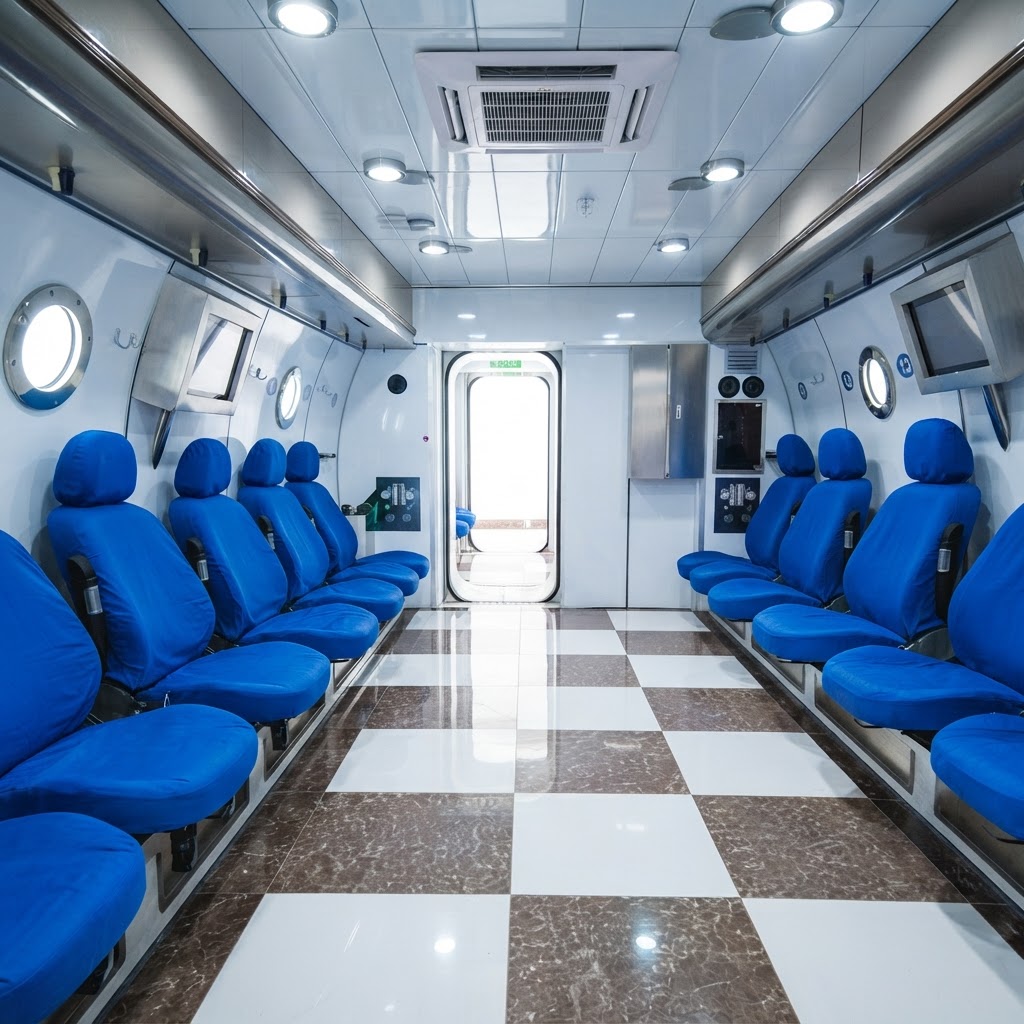
Example of a multiplace hyperbaric chamber from our manufacturing partner — over 1,000 installed in hospitals worldwide.
More than a box of parts
Every chamber purchase from us is a working system — selected, checked, installed and supported. Here's what arrives with your purchase.
The chamber, matched to you
The hardshell chamber and components selected for your pressure range, users and goals — not an off-the-shelf unit.
Arrival verification check
We inspect and verify every chamber on arrival before it is installed, so what turns up is what was specified.
Professional installation
We install the chamber correctly in your space — siting, ventilation and oxygen supply set up to operate safely.
NZ-registered GP consult
A consultation with our own GP is included as part of the selection process, so the chamber suits the person using it.
Hands-on training
We train you and your family to run and operate the chamber safely before handover — not a manual, in-person.
After-sales support & parts
Ongoing technical support and access to parts. A chamber bought from us stays running, not sitting idle waiting on a seal.
Rough pricing by chamber size
Indicative ranges only — final pricing depends on spec, pressure rating and installation, and is confirmed after your GP consult. We never charge more than buying direct.
Single seater
2 ATA · one user · compact footprint
Double seater
2–2.4 ATA · two users · shared sessions
4 seater
2.4–3 ATA · family or small clinic
6+ / multiplace
Up to 6 ATA · commercial · quote on application
All prices are in NZD and indicative only. They exclude site works, electrical upgrades and any ventilation modifications, which are quoted separately once your space is assessed.
Chamber buying — the questions that come up
The practical things most buyers want to know before they talk to us.
What is the lead time from enquiry to installation?
It depends on chamber size, the manufacturer and your site readiness. As a guide, a stocked single or double chamber can be installed within a few weeks; a multiplace or custom-spec chamber is typically eight to twelve weeks plus shipping. We confirm a realistic timeline after your consult.
What electrical supply does a chamber need?
Hardshell chambers draw more power than a standard socket can handle. Most need a dedicated circuit rated for the compressor and oxygen concentrator load — often 15A or higher. We assess your electrical supply as part of installation and tell you upfront if an electrician is needed.
What about ventilation and the room itself?
A chamber needs a room with adequate ventilation, suitable floor load capacity, and an opening large enough to get the chamber inside. A poorly sited chamber is a safety risk and can be costly to relocate. We check all of this before installation.
What warranty comes with the chamber?
Pressure-vessel, door seals and compressor should each be covered in plain writing for a defined term. We supply chambers with clear warranty conditions — and we tell you exactly what is and is not covered before purchase.
How do servicing and parts work?
You get ongoing technical support and access to parts through us. We oversee chamber maintenance so a worn seal or compressor part does not turn into a weeks-long outage. This is one of the biggest reasons to buy locally through an operator rather than importing direct.
How do I verify the chamber is genuinely certified?
Pressure-vessel certification must be specific to hyperbaric operation and verifiable through the issuing body — not a generic electrical or quality certificate. We provide the real paperwork and show you how to confirm it. If a seller cannot, that is a red flag.
Do you supply outside New Zealand?
We supply and install across New Zealand and Australia. For other regions, talk to us — we will tell you honestly whether we can support you properly or refer you to someone who can.
What HBOT may offer older adults — and the case for extending healthspan
A growing body of research is exploring how hyperbaric oxygen therapy might support the cellular, cognitive and physical factors that shape how we age. We present this as an emerging field of study — not as a guaranteed anti-ageing treatment.
Cellular energy & mitochondrial support
Ageing is closely linked to declining mitochondrial function — the cellular engines that produce energy. HBOT involves breathing high oxygen under pressure, which some research suggests may support mitochondrial activity and the body's natural energy production over time.
Telomere & cellular ageing research
A small Israeli study (Hachmo et al., 2020) reported lengthening of telomeres and reduction of senescent cells in healthy older adults after a course of HBOT. This is early-stage research, not a proven outcome — but it points to why HBOT is being studied in the context of ageing.
Cognitive function & brain health
Some studies report improvements in memory, attention and processing speed in older adults after HBOT. Increased oxygen availability and blood flow are thought to be the proposed mechanism. We frame this as an area of active research, not a guaranteed result.
Cardiovascular & circulation support
HBOT may support blood vessel function and circulation — factors relevant to cardiovascular health in later life. This is presented as supportive, not as a treatment for heart disease.
Physical function & recovery
Maintaining muscle, mobility and the ability to recover from exertion is central to healthspan. HBOT is being explored as an adjunct that may help older adults stay active and recover from injury or surgery more readily.
Inflammation & immune resilience
Chronic low-grade inflammation is associated with many age-related conditions. HBOT's effect on inflammatory markers is an active area of study, and some people use it as part of a broader approach to supporting immune resilience.
Healthspan, not just lifespan
Lifespan is how long you live. Healthspan is how long you live well — mobile, independent, clear-minded and active. Most people want more of the latter, and that is where much of the HBOT-ageing research is focused.
Proactive, not reactive
The people exploring HBOT for ageing tend to be those already investing in sleep, nutrition, movement and prevention. HBOT is being considered as one more modality in that proactive toolkit — not a replacement for the fundamentals.
Consistency still applies
As with any use of HBOT, occasional sessions are unlikely to move the dial on something as long-term as ageing. Protocols studied in research involve structured courses, and ongoing or periodic use is typically part of the approach.
Why this matters for owning a chamber: the ageing and healthspan use cases are typically ongoing, not one-off. That makes the case for a home chamber especially strong here — the consistency and long-term access research protocols rely on is exactly what home ownership provides.
Research note: Studies referenced above are early-stage and often involve small samples. Individual responses to HBOT vary, and HBOT is not approved as a treatment for ageing. Suitability screening and a GP consultation are required before any use. Information here is educational and not medical advice.
Consistency is the key to HBOT success — and a home chamber makes consistency easy
After accessing the right pressure, the right levels of oxygen, for the right length of time — the key to hyperbaric success is whether the person completes a consistent, protocol-length course of sessions.
HBOT works cumulatively, not in single hits
Hyperbaric oxygen therapy is a protocol-driven process. The meaningful changes people associate with HBOT — in energy, recovery, sleep, inflammation — tend to come from repeated, scheduled exposure over weeks and months, not from one or two isolated sessions.
Gaps and stop-start treatment slow progress
When sessions are spaced too far apart — because of travel, cost, booking availability, or life — the cumulative effect HBOT depends on gets diluted. A stop-start pattern is one of the most common reasons people finish a course feeling underwhelmed.
Maintenance matters after the initial course
For many people HBOT is not a one-off. After an initial intensive phase, ongoing or periodic sessions help hold the gains. Maintaining that with per-session clinic visits is expensive and inconvenient enough that many people simply stop — and the benefits slowly fade.
How a chamber at home makes consistency easy
The reason people drop out of clinic-based HBOT is almost never motivation. It is friction — the cost, the travel, the scheduling, and the difficulty of getting to repeated appointments when you already feel unwell. Owning your chamber removes that friction.
Treat on your own schedule
No clinic booking, no opening hours. A session takes 60–90 minutes plus prep and decompression — at home that is 90 minutes of your day, not half a day lost to travel, parking and a waiting room.
No per-session cost or travel time
Every clinic visit is time off work, fuel, parking and a per-session fee. Over a full protocol — and certainly over ongoing use — those costs add up fast. A home chamber turns a recurring expense into a one-time investment you own.
The whole household can benefit
One chamber can serve a family, a sports team or a small group. Rather than buying sessions for each person individually, a shared home chamber lets partners, children or teammates each access HBOT as they need it.
Comfort, privacy and a consistent setup
You learn one chamber, in one room, set up exactly for you. There is no adjusting to a different unit or operator each visit, no travelling while unwell, and no waiting rooms — often what makes a full course of treatment actually finishable.
In short: the chamber you own is the chamber you will actually use, consistently, for the length of time HBOT needs to work. That is why owning beats renting sessions for many people — not because it is a better chamber, but because it removes every reason to skip.
Tell us about your chamber needs
A few quick questions so the right technician can call you back with informed guidance — not a sales pitch.
General disclaimer: Information on this page is general in nature and is not medical advice. Suitability for HBOT should be discussed with your GP or treating clinician. Individual responses vary.
Safety notice: Hyperbaric chambers involve pressure and oxygen. Installation, operation and maintenance must follow manufacturer and clinical guidelines. Training is provided with every purchase.
© 2026 Wellington Hyperbarics. All rights reserved.