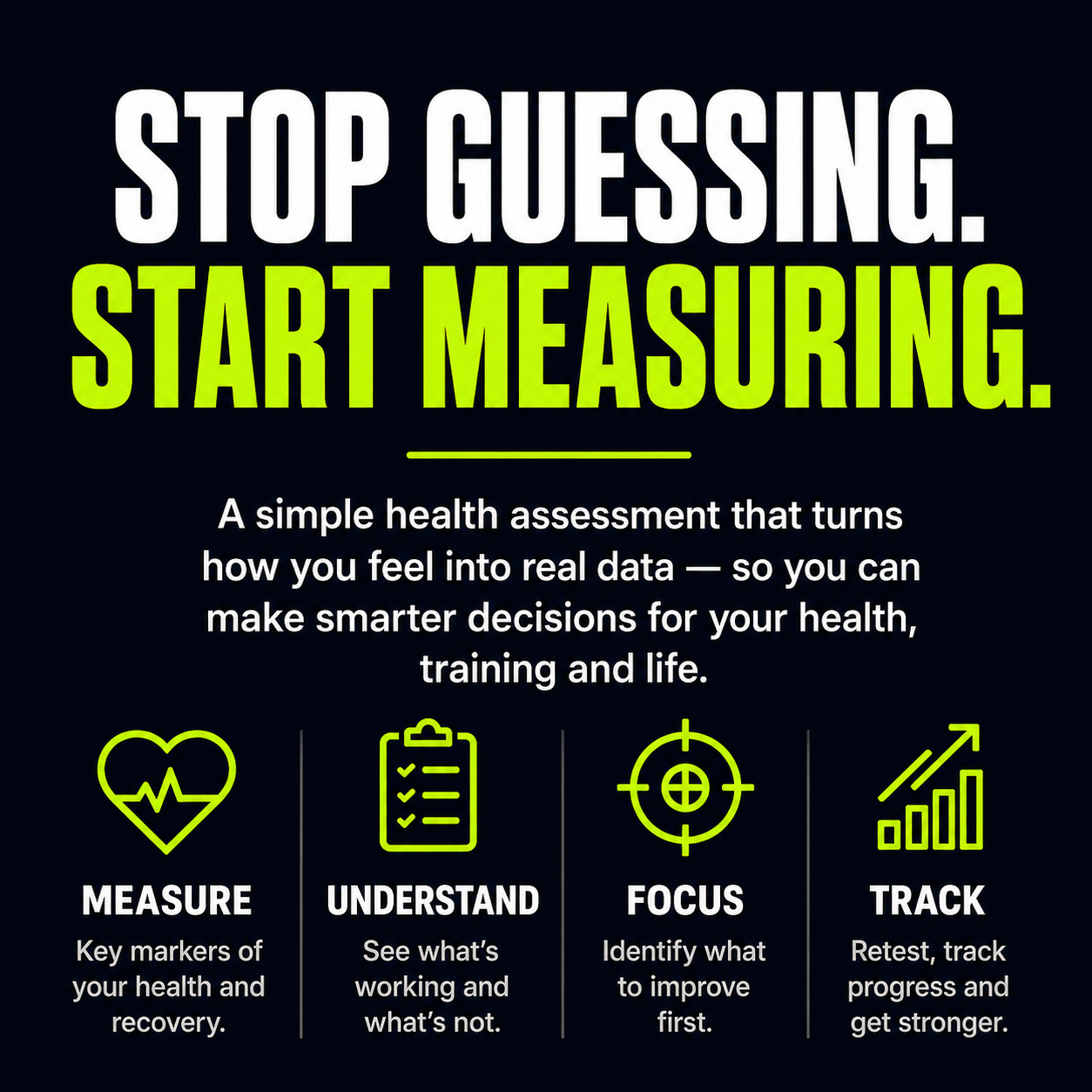
Stop Guessing What Your Body Is Trying to Tell You
Most people do not wake up one day and suddenly lose their energy. It happens quietly.
- You start sleeping a little worse.
- Training feels harder than it should.
- Your brain takes longer to switch on.
- You recover less well after exercise, work, stress or illness.
- Your body feels heavier, even when you are trying to do the right things.
At first, you ignore it. Then you explain it away.
But the problem with guessing is that guessing usually leads to the same advice: train harder, eat better, sleep more, try harder.
Sometimes the issue is not motivation. Sometimes the issue is that your body is carrying more recovery demand than you realise.
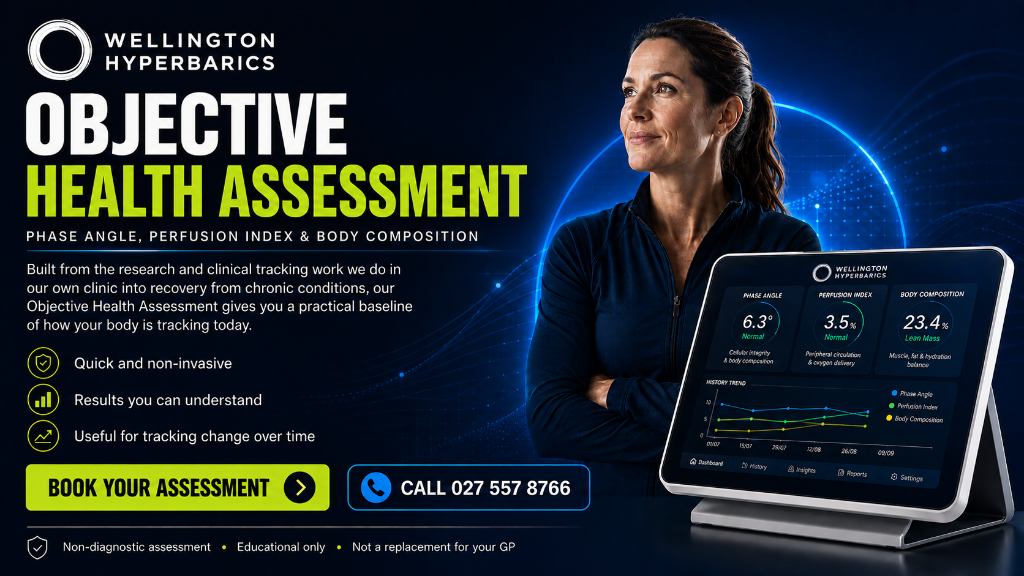
That is what the Objective Health Assessment is designed to show. It gives you something more useful than a guess:
A measurable recovery map, reviewed through Wellington Hyperbarics' clinical governance process under the eye of our own in-house doctor.
What We Look At
The assessment brings together markers from three areas. Individually, each tells part of the story. Together, they show whether your body appears ready to perform, recover and improve.
Oxygen Delivery and Circulation
Your body cannot perform or recover well if oxygen and blood flow are not delivered efficiently.
"Is my body delivering oxygen and blood flow as well as it could?"
Cellular Strength and Body Composition
Two people can weigh the same and have completely different levels of muscle, hydration, fat distribution and cellular resilience.
"Does my body have the physical foundation to recover and improve?"
Recovery Load
Your body does not only recover from exercise. It also has to recover from poor sleep, work stress, pain, brain fog, emotional load, concussion history, and more.
"What is draining my recovery capacity?"
What Makes This Different
Most assessments measure isolated numbers — weight, blood pressure, body fat, fitness. Those numbers are useful, but they do not tell the full story. The Objective Health Assessment connects the dots between how you feel, how you sleep, how you recover, how your body composition looks, and what your goals actually require from your body.
The power is not in one measurement.
The power is in the pattern.
And the report is not simply auto-generated and handed over without oversight. Each assessment is reviewed under Wellington Hyperbarics' in-house doctor-led governance process, so that medically sensitive patterns, safety flags, medication confounders, and possible GP discussion points are handled carefully and responsibly.
Doctor-Overseen. Not a Diagnosis.
Does not replace your GP, specialist, emergency care, or prescribing clinician.
Does not diagnose disease or change medications.
Is reviewed carefully, with attention to safety, red flags, medication confounders, and when further medical discussion may be appropriate.
Stop guessing. Start measuring. Build a better plan.
Because the body usually tells the truth. The question is whether anyone is measuring carefully enough to listen.
Two People. Same Age.
Different Trajectories.
The average New Zealander lives to 82. But average isn't a plan — it's a default. This assessment helps you stop defaulting and start designing.
How old are you?
Drag the slider to see what's at stake
The gap between average and optimised is 12 years. That's 12 more summers. 12 more Christmases. 12 more years to be present.
What You're Playing For
A measurable plan you can share with your partner, your family, and your doctor. Know your numbers. Build your strategy. Live on your terms.
- More years with the people you love
- Sharp cognition well into your 70s and 80s
- A plan you can share with family, partner & GP
- Catch the warning signs before they become problems
- Energy and recovery that keeps pace with your life
Why Trust Us
We've worked alongside elite sports teams, high-performing executives, and some of the most recognised names across NZ and Australia.
"The same health intelligence used by winning teams — now your personal advantage."
What We Measure
The assessment can include phase angle, perfusion index, oxygen saturation, resting heart rate, blood pressure, body composition, hydration and fluid balance, muscle mass, visceral fat, sleep, energy, pain and brain fog scores, medication and supplement review, a multi-page summary and suggested next steps.
Phase Angle
Phase Angle is a bioelectrical impedance marker often used as a broad indicator linked with cellular membrane integrity, hydration balance, nutritional status and body composition quality. It is not a diagnosis, but it can be useful as a trend marker when interpreted carefully.
Perfusion Index
Perfusion Index is a pulse-oximetry-derived marker that reflects the strength of pulsatile blood flow at the sensor site. It is not the same as oxygen saturation. It can provide a window into peripheral circulation, vascular tone and local perfusion.
Body Composition
Weight alone is crude. Body composition can help show whether changes are coming from muscle, fat, fluid or visceral fat. This can make progress tracking more useful than relying on weight by itself.
Oxygen Saturation
Oxygen saturation gives a snapshot of blood oxygen percentage at the time of testing. It is interpreted alongside symptoms, circulation markers and health history.
Recovery Scores
Sleep, energy, pain and brain fog scores help connect the numbers to how the person is actually feeling and functioning.
Who This May Suit
Busy, stressed or tired
For people who feel flat, overloaded or not bouncing back.
Not sick, not thriving
For people who do not feel unwell enough for urgent care, but know they are not functioning at their best.
Recovery tracking
For people recovering from chronic conditions who want practical markers to follow over time.
Health optimisation
For people who want objective data to guide better decisions around recovery, nutrition, sleep and wellness.
30s, 40s, 50s and 60s
For people who want to understand their baseline before things become harder to shift.
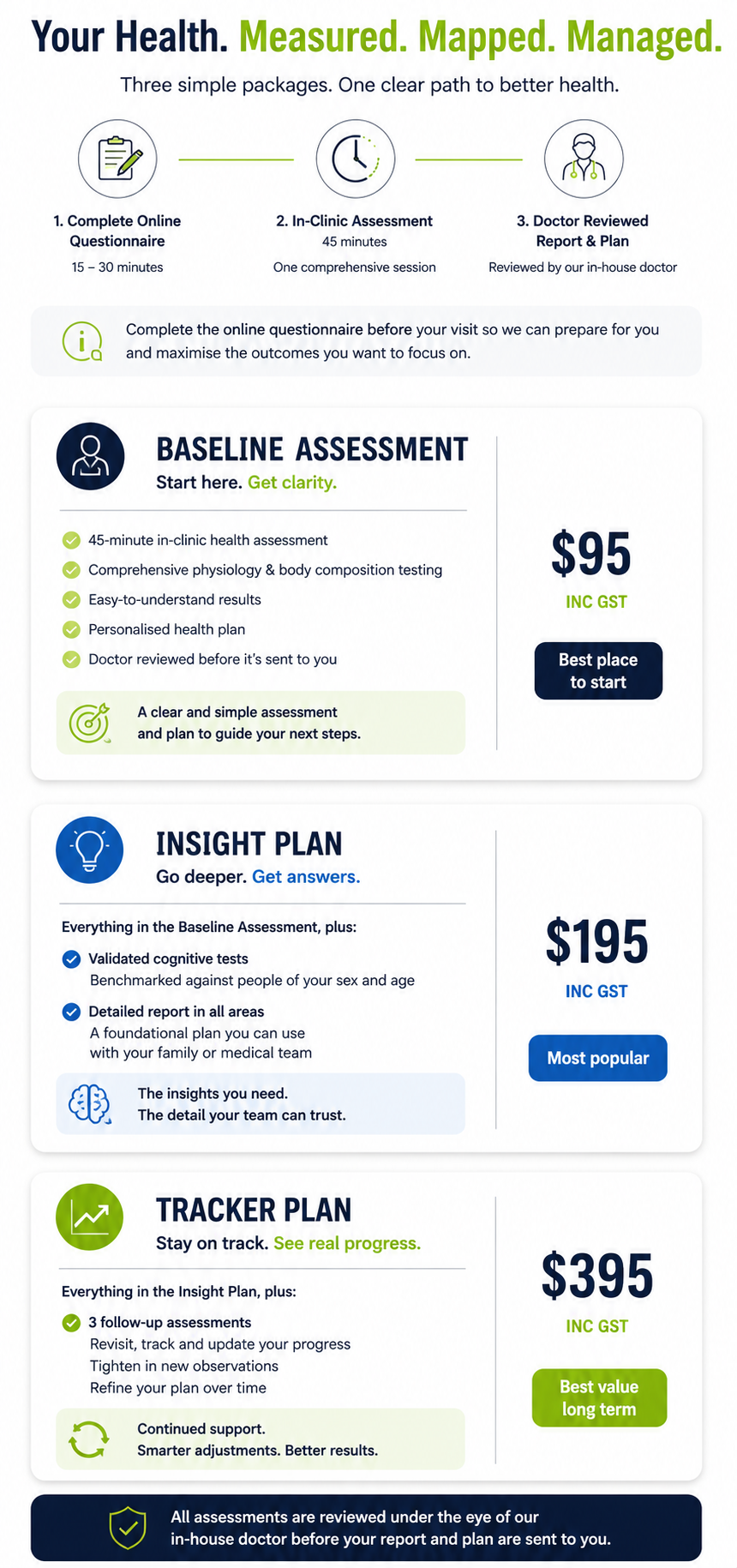
Choose Your Level of Insight
Frequently Asked Questions
Book Your Assessment
Fill in your details below and our team will confirm your appointment.
Because the worst strategy is guessing.
Get measured. Understand your baseline. Track your recovery.
This service is designed to support education, baseline tracking and recovery-readiness monitoring. It does not diagnose disease or replace medical care. Individual results vary.
© 2026 Wellington Hyperbarics. All rights reserved.
Two People. Same Age.
Completely Different Capacity.
This isn't about vanity or athletic performance. It's about the functional gap that opens between people who measure and act early — and those who don't.
The gap isn't genetics. It's not luck. It's measurement and action.
One assessment gives you the starting point. Everything else follows from that.
Research Basis
Healthspan vs Lifespan gap
The average person spends 9–12 years at end of life in chronic disease or disability. Olshansky SJ (2015). Lifespan and Healthspan: Past, Present, and Promise.
Cardiovascular decline — trained vs sedentary
Sedentary adults lose ~10% VO₂ max per decade; trained adults lose ~5.5%. Hagberg et al. (1985). Decline in VO2max with aging in master athletes and sedentary men.
50–70% of VO₂ max decline is preventable
The majority of age-related cardiovascular decline is attributable to inactivity, not biology. Multiple longitudinal studies reviewed by DexaFit / Healthspan Institute.
Cognitive function — exercise intervention
Aerobic and resistance training produce significant improvements in executive function and memory vs sedentary controls (SMD 0.55–0.88). Frontiers in Aging Neuroscience (2025).
Phase angle as predictor of frailty & physical function
Phase angle (bioelectrical impedance) is a validated marker of sarcopenia, frailty, and functional decline in older adults. PMC9715408 (2022).
These references support the directional comparisons shown. This tool is educational only and does not constitute medical advice.
General disclaimer: Wellington Hyperbarics provides educational, assessment and adjunctive wellness support. Information on this website is not medical advice, is not a diagnosis, and does not replace your GP, specialist, emergency care or prescribing clinician. Suitability screening is required before HBOT. Individual responses vary. Medication decisions should always be made with the prescribing clinician.
Safety notice: HBOT involves pressure exposure and oxygen use. Potential risks include ear, sinus or dental barotrauma, oxygen-related adverse effects, fatigue changes and claustrophobia. Some medical conditions require medical review before treatment.
AI governance: AI-assisted tools may be used internally to organise information and draft reports. Reports are reviewed through Wellington Hyperbarics' clinical governance process before being shared. AI output is not used as a standalone diagnosis or treatment decision.
© 2026 Wellington Hyperbarics. All rights reserved.